Payroll
HR → Payroll turns each month's salary structures, attendance and leave into payslips. This is the flagship page of the module: it runs August 2026 payroll for R. Mehta end to end, deriving every figure — PF, ESI, Professional Tax, TDS and the LOP deduction — and lands on his net pay of ₹27,000.
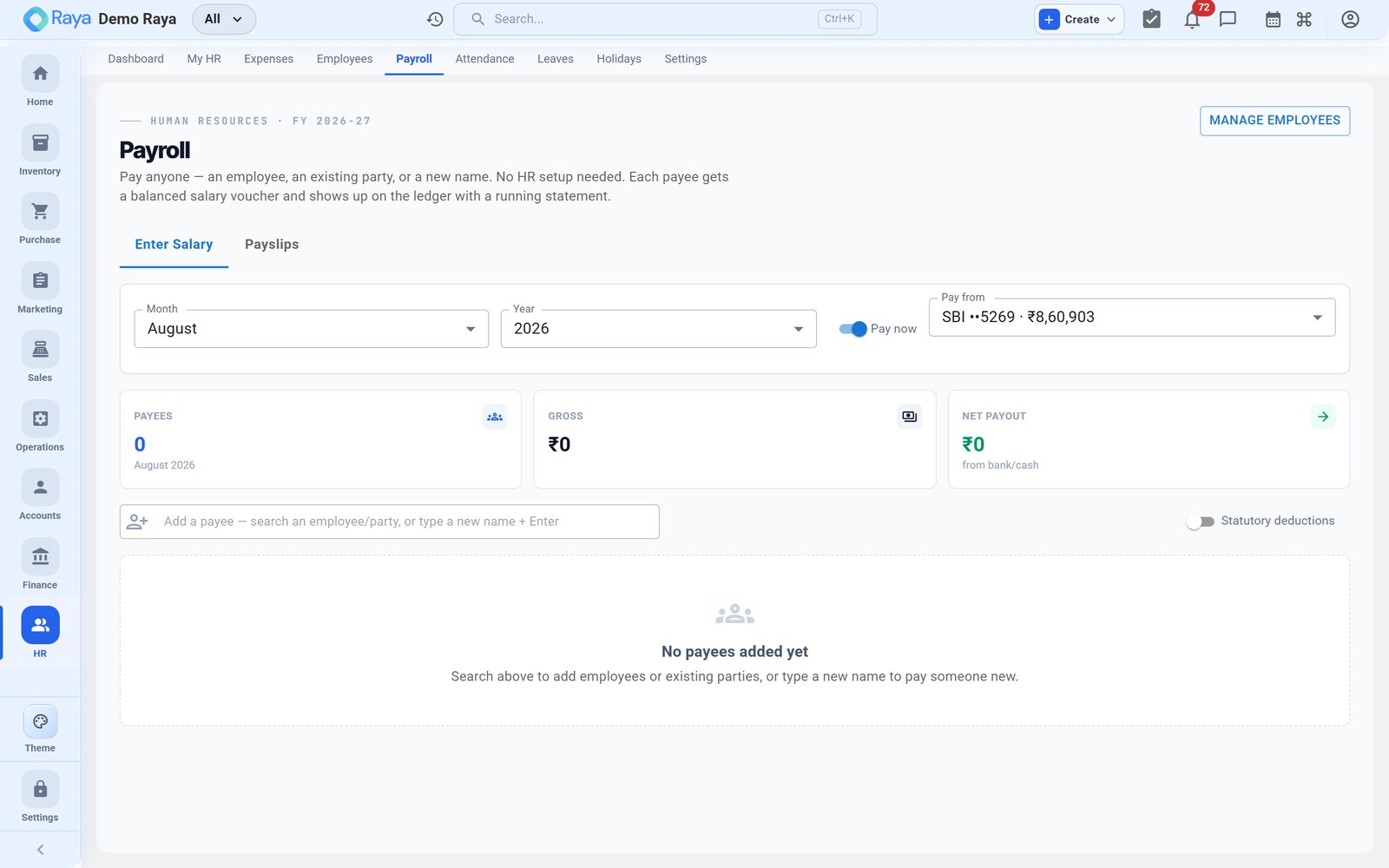
Run monthly payroll
Payroll is processed in monthly cycles (payroll periods). Nothing is typed at pay time — the run gathers what the other pages already recorded.
- Open the payroll period for the month — here August 2026.
- Raya pulls each active employee's salary structure (Employees), plus attendance/overtime (Attendance) and approved leave (Leave) for the period.
- Review the computed earnings and deductions for each employee.
- Generate payslips for the period.
The statutory rates you configure
PF, ESI, Professional Tax and TDS are set up once as deduction components in the salary structure; the run applies them each month. These are the current Indian rates you'll configure them to.
| Item | Employee | Employer | Computed on | Key rule |
|---|---|---|---|---|
| Provident Fund (EPF) | 12% | 12% | Basic (+ DA) | Statutory wage ceiling ₹15,000 basic |
| ESI | 0.75% | 3.25% | Gross wages | Only if gross ≤ ₹21,000/month |
| Professional Tax | State slab | — | Gross | State tax, capped at ₹2,500/year |
| TDS (income tax) | Per slab | — | Projected annual salary | New or old regime |
:::info Statutory filing is on the roadmap Raya computes these amounts on the payslip, but automated filing — PF/ESI returns, PT challans, TDS challans and Form 24Q — is planned, not live. Treat the figures below as what to remit through the government portals yourself. :::
Provident Fund (PF)
Employee PF is 12% of Basic. For R. Mehta: 12% × ₹15,000 = ₹1,800.
The employer also contributes 12% of basic (₹1,800). Of the employer's share, 8.33% (up to the ₹15,000 wage) goes to the Pension (EPS) portion and the rest to EPF. R. Mehta's basic is exactly at the ₹15,000 ceiling, which keeps the maths clean.
ESI
ESI is 0.75% employee + 3.25% employer of gross wages, but it only covers employees earning gross ₹21,000/month or less.
:::note ESI does not apply to R. Mehta His gross is ₹30,000, above the ₹21,000 ceiling — so ESI is Not Applicable and there is no ESI line on his payslip. This is the correct outcome, not an omission. :::
Worked ESI example (for an in‑ceiling colleague). Take S. Kumar, a helper on ₹18,000 gross — within the ceiling, so ESI applies:
| ESI contribution | Rate | Amount |
|---|---|---|
| Employee | 0.75% × 18,000 | ₹135 |
| Employer | 3.25% × 18,000 | ₹585 |
ESI is computed on gross (not just basic). Once an employee is in ESI at the start of a contribution period (Apr–Sep or Oct–Mar), they stay in for the whole period even if a mid‑period raise lifts them past ₹21,000.
Professional Tax (PT)
PT is a state tax, so the slab depends on the employee's work‑location state. R. Mehta works in Pune (Maharashtra); the Maharashtra slab is:
| Monthly gross | PT / month |
|---|---|
| Up to ₹7,500 | Nil |
| ₹7,501 – ₹10,000 | ₹175 |
| Above ₹10,000 | ₹200 (₹300 in February) |
His gross ₹30,000 is above ₹10,000 → ₹200 for August. (States such as Delhi, Haryana and UP levy no PT at all; Karnataka, West Bengal and Tamil Nadu use their own slabs.)
TDS
TDS spreads the year's estimated income tax across 12 months. For R. Mehta:
- Projected annual gross:
₹30,000 × 12 = ₹3,60,000. - Under the new regime, standard deduction ₹75,000 → taxable ≈ ₹2,85,000.
- That's below the basic exemption, so annual tax = ₹0 → TDS = ₹0.
So R. Mehta has no TDS. For a higher earner it would be the annual tax ÷ 12, adjusted as the year progresses; you configure TDS as a deduction component and enter the monthly amount.
R. Mehta's inputs for August
| Input | Value | Source |
|---|---|---|
| Salary structure | ₹30,000 (Basic 15,000 / HRA 6,000 / Allow. 9,000) | Employees |
| Overtime | 0 hours | Attendance |
| Approved paid leave | 2 days casual (paid) | Leave |
| LOP days | 1 (6 Aug, uncovered absence) | Attendance |
Loss of Pay (LOP)
LOP prices each unpaid day and deducts it. Raya's default basis is a fixed 30‑day month (configurable to calendar days or working days):
Per‑day pay = Gross ÷ 30 = 30,000 ÷ 30 = ₹1,000
LOP deduction = 1 day × ₹1,000 = ₹1,000
The 2 casual days are approved and paid, so they do not appear here — only the uncovered day does.
The payslip — August 2026
Earnings
| Earning | Amount (₹) |
|---|---|
| Basic | 15,000 |
| HRA | 6,000 |
| Special / Other Allowances | 9,000 |
| Overtime | 0 |
| Gross earnings | 30,000 |
Deductions
| Deduction | Basis | Amount (₹) |
|---|---|---|
| Loss of Pay (1 day) | 30,000 ÷ 30 | 1,000 |
| Provident Fund (employee) | 12% × 15,000 | 1,800 |
| ESI (employee) | Gross > ₹21,000 → N/A | 0 |
| Professional Tax | Maharashtra slab | 200 |
| TDS | Below taxable threshold | 0 |
| Total deductions | 3,000 |
Net pay
Net pay = Gross earnings − Total deductions
        = 30,000 − 3,000
        = ₹27,000
R. Mehta's net pay for August 2026 is ₹27,000. Click Generate payslip and it becomes a downloadable PDF he can also see in the self‑service portal.
Cost centre allocation
Each employee's cost is tagged to a cost centre — their department — so payroll lands against the right part of the business. R. Mehta's cost is allocated to Production. His full cost to the company for August is:
| Component | Amount (₹) |
|---|---|
| Gross earned (after LOP) | 29,000 |
| Employer PF (12% of basic) | 1,800 |
| Cost to company — Production | 30,800 |
:::info Posting payroll to Finance is on the roadmap Automatic posting of the payroll journal into Finance is planned. Today you record it once a month as a manual journal voucher, tagged to the Production cost centre:
Dr  Salaries & Wages — Production ............. 29,000
Dr  Employer PF Contribution — Production ...... 1,800
    Cr  EPF Payable (1,800 employee + 1,800 employer) . 3,600
    Cr  Professional Tax Payable ..................... 200
    Cr  Net Salary Payable (R. Mehta) ............ 27,000
                                        ------------------
                                        30,800   30,800  ✓ balanced
See Vouchers for how to post a journal. :::
What a payslip shows, in general
| Earnings | Deductions |
|---|---|
| Basic | Provident Fund (PF) |
| HRA (House Rent Allowance) | ESI (if within the ₹21,000 ceiling) |
| DA (Dearness Allowance) | Professional Tax (PT) |
| Other allowances | TDS |
| Overtime | Loss of Pay (LOP) |
- LOP is calculated automatically from unauthorised absence and unpaid leave.
- Overtime hours from attendance are added to earnings.
- Statutory items (PF, ESI, PT, TDS) are configured as deduction components.
:::info Bank‑file export is on the roadmap Raya doesn't yet produce a bank upload file for bulk disbursement. Use the net‑pay figures from the payslips to pay salaries from your bank. :::
Related
- Employees — the salary structure that seeds the run.
- Attendance — overtime and LOP inputs.
- Leave — approved leave that keeps pay whole.
- Vouchers — post the payroll journal in Finance.
- Settings — payroll roles and permissions.