Work Orders, BOM & Routing
A Work Order (WO) is an instruction to either manufacture a finished good or transfer stock between locations. It is the engine of the Operations module: it explodes a BOM against a build quantity, sequences a routing, draws material from stores, drives the shop floor, and rolls every rupee of material and conversion into a per-unit cost. This page works one manufacturing order end to end.
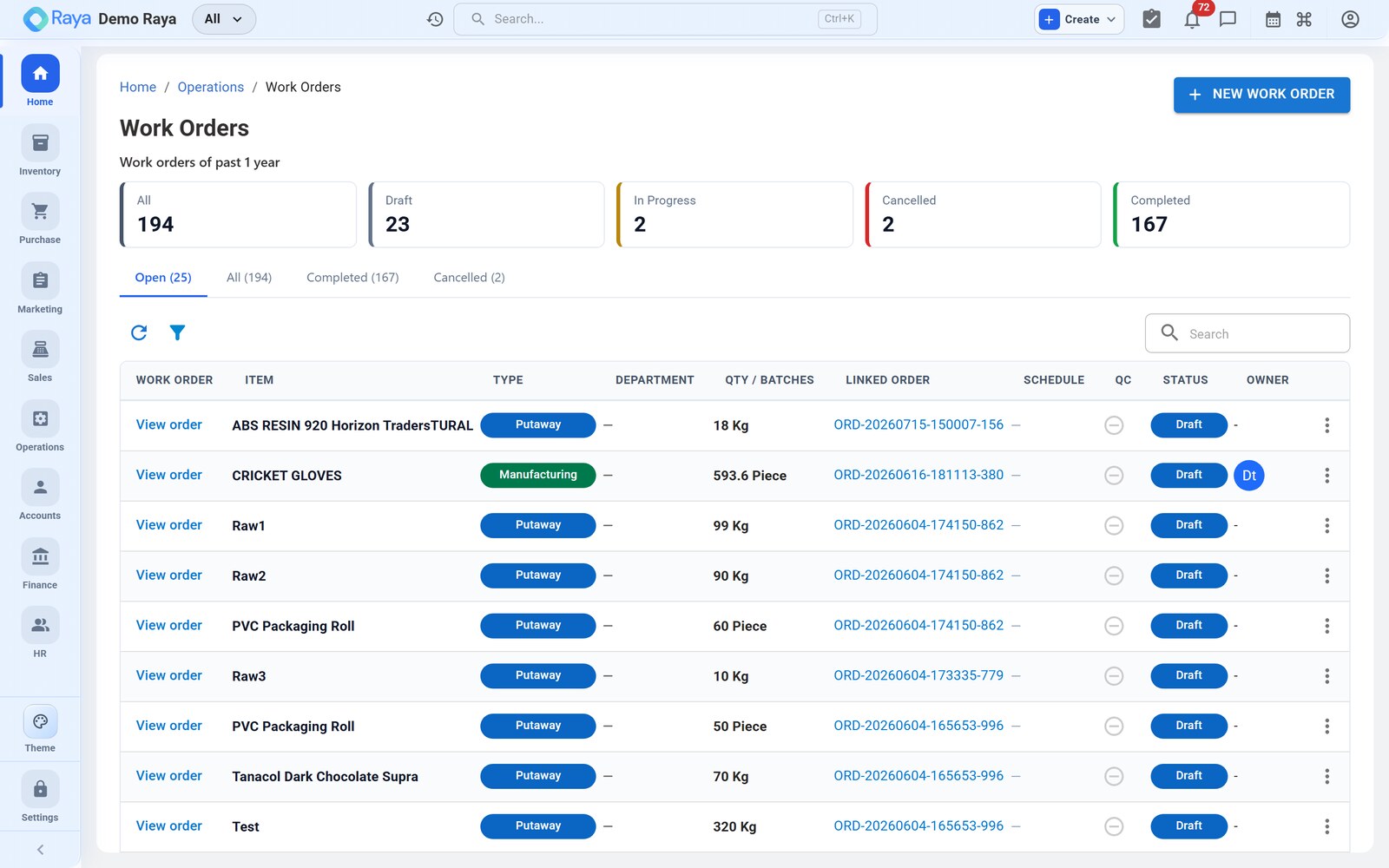
Worked scenario — WO-2418: build 2,000 × 50 L HDPE Drum
The Produce allocation on SO-1290 raised WO-2418. Its master data:
| Field | Value |
|---|---|
| Type | Manufacturing |
| Finished item | 50 L HDPE Drum (Finished Goods, HSN 3923) |
| Quantity to produce | 2,000 |
| From location | Raw Material Stores |
| To location | Finished Goods — Warehouse A |
| Due date | 12 days out |
| Standard cost | ₹214 / drum → WO value ₹4,28,000 |
Everything below scales this recipe by 2,000 and tracks it to completion.
Work order types
- Manufacturing — make a finished good from its raw materials (the focus of this page).
- Internal Transfer — move an item from one location to another (covered at the end).
The BOM behind the drum
A Bill of Materials is the recipe for one finished unit, including a per-component scrap %. WO-2418 loads this automatically:
| Component | Qty / drum | Scrap % | Rate | Cost / drum |
|---|---|---|---|---|
| HDPE Granules Grade A | 2.4 kg | 1.2% | ₹80/kg | ₹192.00 |
| Masterbatch Blue | 40 g | 1.2% | ₹250/kg | ₹10.00 |
| Lid + gasket set | 1 | — | ₹6.00 | ₹6.00 |
| Material / drum | ₹208.00 |
The routing (process steps)
A routing defines the ordered operations — with work centre/machine, setup time and cycle time — used to sequence and cost production. The drum's routing:
| Seq | Operation | Work centre | Setup | Cycle / drum | Conversion / drum |
|---|---|---|---|---|---|
| 10 | Extrusion | Extruder EX-2 | 30 min | 22 s | ₹1.20 |
| 20 | Blow moulding | Blow moulder BM-1 | 20 min | 35 s | ₹1.30 |
| 30 | Trimming | Trim station TR-1 | 10 min | 12 s | ₹0.40 |
| 40 | Packing | Pack bench PK-1 | 5 min | 15 s | ₹0.60 |
| Conversion / drum | ₹3.50 |
Per-unit standard cost rollup
Material + scrap allowance + conversion gives the standard cost the work order is valued at:
| Element | Amount / drum |
|---|---|
| Direct material (2.4 kg HDPE + 40 g masterbatch + lid) | ₹208.00 |
| Scrap allowance @ 1.2% of material | ₹2.50 |
| Conversion (routing labour + machine overhead) | ₹3.50 |
| Standard cost / drum | ₹214.00 |
| × 2,000 drums = work order standard value | ₹4,28,000 |
Create a manufacturing work order
Go to Operations → Work Orders → + New Work Order and set:
- Type — Manufacturing.
- Finished Item — the 50 L HDPE Drum (must be Finished Goods with a BOM).
- Quantity to produce — 2,000.
- From Location — Raw Material Stores (where components sit).
- To Location — Finished Goods — Warehouse A (where drums land).
- Due date, and optional priority.
The BOM loads automatically — each component × 2,000, grossed up for scrap — and can be adjusted for this one order (e.g. a temporary substitute granule) without touching the master BOM. The routing comes with the item if it has one.
Work order lifecycle
Draft → Released → In Progress → QC → Completed
                        (or Cancelled)
| Status | What happens |
|---|---|
| Draft | Being prepared; nothing reserved yet. Edit BOM/routing freely. |
| Released | Raw materials are reserved in stores. In Advanced, releasing generates job cards — one per routing step. |
| In Progress | Production is live. Operators log actual quantities consumed and scrap (with a reason). Materials are deducted (Manufacturing Consumption). |
| QC | Output is routed to Quality Control. |
| Completed | Finished goods are added to the To Location (Manufacturing Output). |
Releasing to the shop floor
Releasing WO-2418 reserves its materials and, under Advanced Manufacturing, breaks the order into job cards — one per routing step, in sequence. The reserved material picture:
| Component | Per drum | × 2,000 + scrap | Rate | Reserved value |
|---|---|---|---|---|
| HDPE Granules Grade A | 2.4 kg | 4,857.6 kg | ₹80/kg | ₹3,88,608 |
| Masterbatch Blue | 40 g | 80.96 kg | ₹250/kg | ₹20,240 |
| Lid + gasket set | 1 | 2,024 | ₹6 | ₹12,144 |
| Total reserved | ₹4,20,992 |
:::note Advanced only Multi-level work-order trees (sub-assemblies feeding an assembly feeding the finished good) and job cards require Advanced Manufacturing in Settings → Feature flags. On the Standard tier a work order is single-level: you record consumption and output on the order itself without per-step job cards. :::
Stage-wise progress on the job cards
Operators clear the four job cards in order, logging pass/fail counts and machine time as they go. A snapshot mid-run:
| Job card | Operation | Done | Scrap logged | Reason |
|---|---|---|---|---|
| JC-01 | Extrusion | 2,024 | 12 | Off-cut / purge |
| JC-02 | Blow moulding | 2,012 | 8 | Short shot |
| JC-03 | Trimming | 2,004 | 4 | Flash reject |
| JC-04 | Packing | 2,000 | — | — |
Each cleared job card posts its updates straight to stock and costing — you never re-key the numbers into the ledger.
Material issue and backflush
There are two ways components leave stores:
- Issue — the storekeeper explicitly issues components against the released work order (good when material is drawn in stages).
- Backflush — components are consumed automatically in BOM proportion the moment output is confirmed at a step, so the operator never files a separate issue slip.
When WO-2418 goes In Progress, the actual consumption is recorded (here backflushed per the granules the moulders actually drew):
| Component | Planned (with scrap) | Actual consumed | Rate | Actual value |
|---|---|---|---|---|
| HDPE Granules Grade A | 4,857.6 kg | 4,872 kg | ₹80/kg | ₹3,89,760 |
| Masterbatch Blue | 80.96 kg | 81 kg | ₹250/kg | ₹20,250 |
| Lid + gasket set | 2,024 | 2,020 | ₹6 | ₹12,120 |
| Actual material | ₹4,22,130 |
The gap between actual (₹4,22,130) and planned (₹4,20,992) is a material usage variance of ₹1,138 (unfavourable) — the moulders ran slightly hot on granules. Raya surfaces this in the costing rollup rather than hiding it in the finished-goods value.
:::caution Log scrap with a reason Every scrap unit must carry a reason (defective, off-cut, purge, evaporation). Scrap is posted as an Adjustment Decrease against stock, keeping material variance visible in the stock movement report — don't bury a bad run by inflating "consumed". :::
Stock and costing effects
| Event | Stock move | Effect |
|---|---|---|
| Released | Reservation | ₹4,20,992 of raw material committed (not yet deducted). |
| In Progress | Manufacturing Consumption | Raw material −₹4,22,130 from stores. |
| Scrap logged | Adjustment Decrease | Scrapped material written off, with reason. |
| Completed | Manufacturing Output | 2,000 drums added to Finished Goods at the rolled-up build cost, updating the drum's weighted-average cost. |
Actual rollup for the batch:
Actual material consumed .......... ₹4,22,130
Conversion applied (2,000 × ₹3.50)  ₹7,000
                                    ---------
Actual build cost ................. ₹4,29,130
Good units ........................ 2,000
Actual cost / drum ................ ₹214.57   (vs standard ₹214.00)
The ₹0.57/drum difference (₹1,130 across the batch) is the production variance.
:::note COGS comes later, at dispatch Completing the work order only moves inventory (raw material out, finished goods in) — it does not post COGS. The P&L hit happens when the drums ship: the delivery order posts the Sales and COGS vouchers. Until then the drums sit in finished-goods stock at ₹214/unit. :::
Internal transfer work orders
Simpler than manufacturing: set Type = Internal Transfer, pick the item, quantity, From and To locations, and a due date. There is no BOM or routing. On Released a Transfer Out entry leaves the source; on Completed a Transfer In entry lands the stock at the destination — for example moving the finished drums from Warehouse A to a dispatch dock closer to the loading bay.
Related
- Bill of Materials (BOM) — the recipe a manufacturing work order explodes.
- Quality Control — inspecting work-order output.
- Costing & Reports — how consumed material and conversion feed product cost.
- Subcontracting — outsourcing a routing step (Advanced).
- Make-to-Order workflow — how work orders fit end to end.