Purchase Returns & Debit Notes
A purchase return sends goods back to the vendor — because they were defective, short‑dated or simply not wanted. It raises a debit note that reverses the stock and the input GST (ITC) you had claimed, and reduces what you owe the vendor.
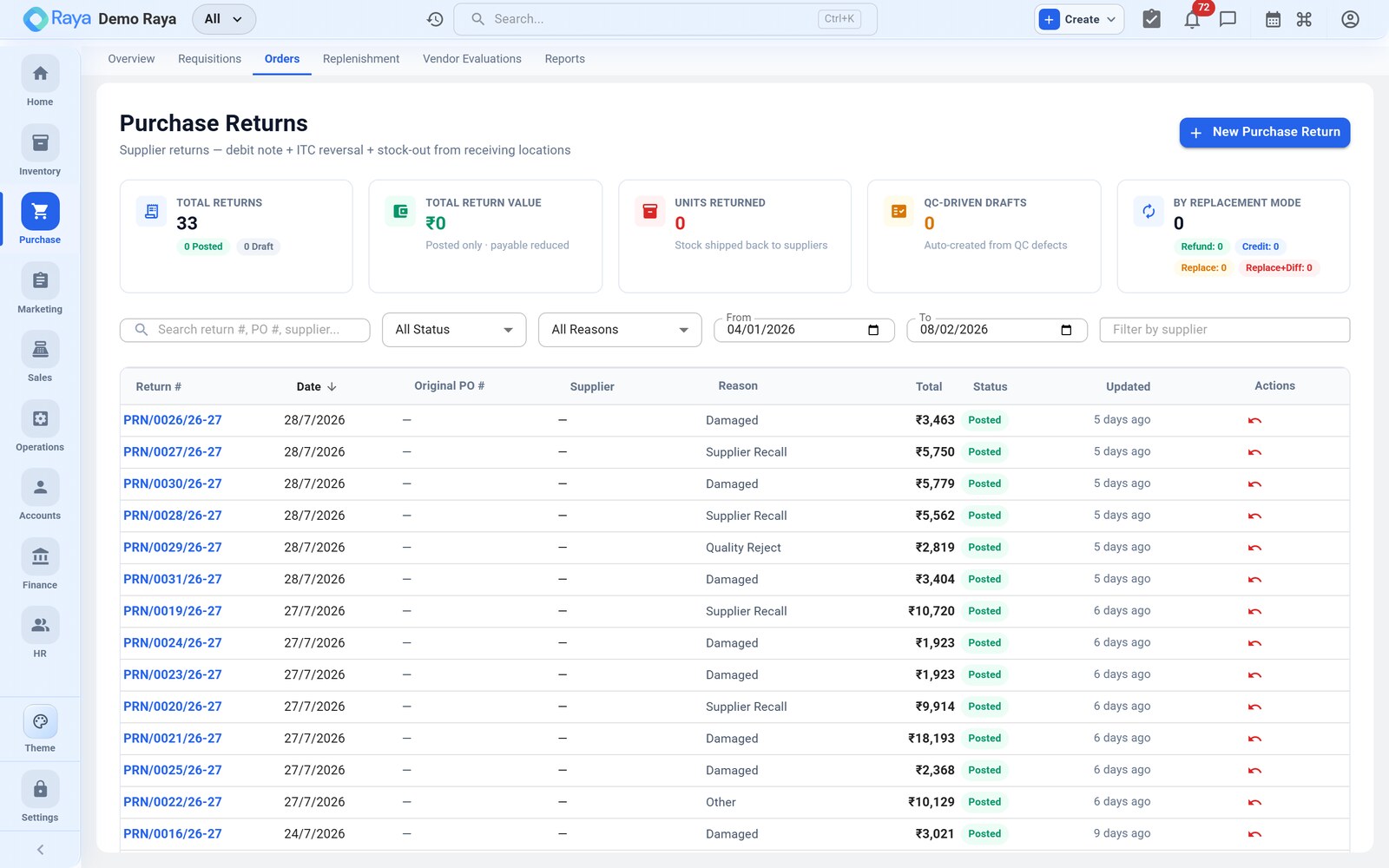
What we're sending back
On GRN‑1187, 0.5 MT of HDPE Granules came in as wet, contaminated bags and was quarantined. That stock never entered available inventory, and now goes back to Gujarat Polychem on a debit note. At the PO rate of ₹27,600/MT that's ₹13,800 of goods plus ₹2,484 of IGST:
| Value | |
|---|---|
| Defective HDPE — 0.5 MT × ₹27,600 | ₹13,800 |
| IGST @ 18% (reversed) | ₹2,484 |
| Debit note total | ₹16,284 |
When you'll use it
- Defective quantity picked up during the goods‑receipt quality check (our case).
- Damage or a spec mismatch found after putaway.
- Over‑supply, or the wrong items shipped by the vendor.
:::tip Defective quantity auto‑drafts a return The 0.5 MT flagged defective on GRN‑1187 auto‑drafts a return for you. Open the draft, confirm what's going back, and post it — no need to key the item, quantity or batch again. :::
1. Raise the return — step by step
- Open the source PO‑3391 or GRN‑1187 and choose Return (or start fresh at Purchase → Returns → + New Return). Opening the auto‑drafted return pre‑fills the vendor, item, quantity and batch.
- Confirm the vendor (Gujarat Polychem) and the line to send back — HDPE Granules, 0.5 MT.
- For batch‑tracked items, confirm the batch/lot being returned — B‑HDPE‑2607 — so the right stock and its exact cost reverse.
- Enter a reason (Defective) and any vendor return / RMA reference the supplier gave you.
- Post the return. Raya raises debit note DN‑0574 against the vendor.
2. What happens on posting (Dr/Cr)
Posting mirrors the original purchase in reverse — it is a Debit Note voucher:
Dr  Accounts Payable (Gujarat Polychem) ... 16,284
    Cr  Purchase Returns (Inventory) .......... 13,800
    Cr  Input IGST (ITC reversal) .............. 2,484
Line by line, posting the return:
- Stock — the 0.5 MT is removed from the Quarantine sub‑location; net HDPE retained falls to 29.0 MT.
- Debit note — DN‑0574 is raised against the vendor, reducing what you owe.
- Input GST / ITC — the ₹2,484 of IGST claimed on those goods is reversed, so your ITC only ever reflects goods you kept.
- Vendor ledger — Gujarat Polychem's payable is reduced by the ₹16,284 debit note value.
:::caution Reverse the ITC, don't just drop the stock A purchase return isn't only a stock movement — the input tax credit must be reversed too, or your GSTR‑3B over‑claims ITC on goods you sent back. Posting the debit note does both in one entry; never adjust stock for a return without the matching debit note. :::
3. Settling the debit note
The debit note can be adjusted against the vendor's bill (our case), against other outstanding, or the vendor may issue a refund. Finance allocates it bill‑wise, the same way payments are matched, so the vendor account always ties out.
Recall the numbers from the three‑way match: bill VB‑2094 left ₹10,84,916 in Accounts Payable (₹10,85,836 less ₹920 §194Q TDS). Applying DN‑0574 brings the net payable down:
Bill VB-2094 — Accounts Payable ..... 10,84,916
Less debit note DN-0574 ............. (  16,284)
                                     -----------
Net payable to Gujarat Polychem ..... 10,68,632
When Finance pays on the due date (05 Sep 2026), the Payment voucher clears the net balance:
Dr  Accounts Payable (Gujarat Polychem) ... 10,68,632
    Cr  Bank ................................... 10,68,632
Separately, the withheld tax is remitted to the government by its due date:
Dr  TDS Payable (§194Q) ... 920
    Cr  Bank ..................... 920
After all of this, the vendor's payable is nil, ITC reflects only the 29.0 MT + 400 kg you kept, and the ₹920 sits in TDS Payable until the challan is filed. The PO closes once the short 0.5 MT is either re‑shipped or written off.
:::note GST reporting Debit notes flow into your GST returns (GSTR‑1 CDNR) and the GSTR‑2A/2B reconciliation, keeping your input‑tax credit accurate after the reversal. The original bill number is preserved on the note so the portal can link them. :::
Related
- Goods Receipt (GRN) — where the 0.5 MT defective was flagged.
- Purchase Orders — the PO the return traces back to.
- Vouchers — Debit Note and Payment entries in detail.
- TDS — the §194Q challan the remittance settles.
- Procure‑to‑Pay workflow — the full cycle, end to end.
- Inventory — stock and batch movements.