Sales Returns & Credit Notes
When a customer sends goods back or an invoice needs correcting, a sales return restocks the items by their condition and a credit note reverses the money — keeping stock, GST and the ledger in balance. This page runs a partial return on SO-1043 / INV-2045: Sunrise Polymers sends back 1 MT of the 4 MT LDPE Film.
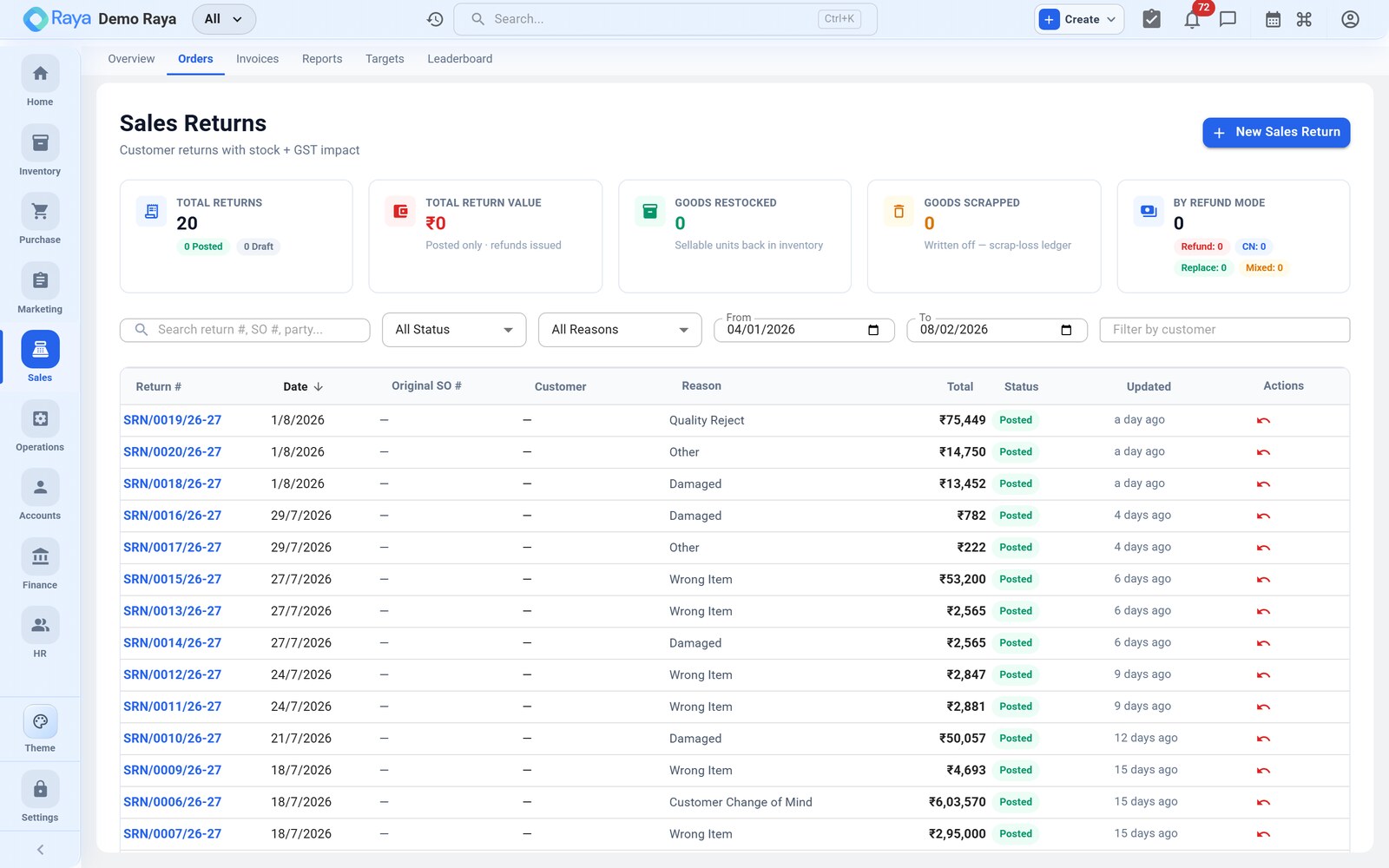
The return we are processing
Sunrise Polymers has already paid INV-2045 in full (₹5,68,760). One tonne of LDPE Film arrived off-spec, so they return it. We credit only that line:
| Returned line | Qty back | Rate (₹) | Taxable (₹) | IGST 18% (₹) | Credit total (₹) |
|---|---|---|---|---|---|
| LDPE Film (HSN 3920) | 1 MT | 39,500 | 39,500 | 7,110 | 46,610 |
The other 15 MT (all the HDPE, plus 3 MT LDPE) stay sold — this is a partial credit note, not a full reversal.
Raise the credit note
- Start from the original invoice — Sales → Credit Notes → + New — and pick INV-2045. Raya loads its lines, GSTIN and tax treatment (IGST 18%).
- Select the lines and quantities coming back — set LDPE Film to 1 MT, leave HDPE untouched.
- Choose how to restock by condition (see below) for the returned tonne.
- Confirm the credit note number and date (e.g.
CN-0231). The credit note inherits INV-2045's IGST treatment, so the tax reverses at exactly the rate it was charged. - Post. Raya generates the credit-note PDF and auto-adjusts the ledger.
:::note Same tax as the original A credit note always reverses the sale using the original invoice's GST treatment. Because INV-2045 was inter-state, CN-0231 credits Output IGST, not CGST/SGST — so it lands correctly in GSTR-1 (CDNR) against the original document. :::
Restock by condition
Only good stock should return to the sell-able shelf, so each returned line is restocked by its condition — and the accounting follows the physical decision:
| Condition | What happens to stock | Effect on COGS |
|---|---|---|
| Good | Added back to the chosen sell-able location, available to sell again. | COGS is reversed for the restocked value. |
| Damaged | Held aside or scrapped — never returned to available stock. | COGS is not reversed; a scrap/write-off is booked instead. |
| Expired | Quarantined or scrapped, never re-sold. | COGS not reversed; written off. |
For SO-1043 the returned tonne is inspected as Good, so it goes back to the Gujarat location and its cost comes back into inventory.
The reversing entries
Posting CN-0231 books the mirror image of the parts of INV-2045 being undone. The Credit Note voucher reverses the sale and the tax, reducing what the customer owes:
Dr  Sales                                     39,500
Dr  Output IGST @18%                            7,110
        Cr  Sunrise Polymers (Accounts Receivable)   46,610
Because the tonne came back in Good condition and was restocked, the COGS voucher is reversed for that line's FIFO cost (1 MT LDPE @ ₹35,000):
Dr  Inventory                                 35,000
        Cr  Cost of Goods Sold                    35,000
Net effect: revenue drops ₹39,500, output tax drops ₹7,110, one tonne of LDPE is back on the shelf, and the margin on this return unwinds cleanly (₹39,500 − ₹35,000 = ₹4,500 of margin reversed).
:::caution Damaged goods break the symmetry If the tonne had come back Damaged, you would not post the inventory-restock entry above. Instead the cost sits in scrap/loss — the sale still reverses (customer gets their ₹46,610 credit), but the ₹35,000 does not return to sell-able inventory. Match the accounting to the physical condition, not the invoice. :::
Credit note → refund or set-off
Sunrise had already paid in full, so CN-0231 leaves their account ₹46,610 in credit (their receivable is now negative — you owe them). Two ways to settle it:
- Refund now — record a payment against the credit note; Raya posts
Dr Sunrise Polymers (AR) 46,610 / Cr Bank 46,610, clearing the balance to nil. - Leave it on account — keep the ₹46,610 as a credit that auto-offsets their next invoice, so the following order bills ₹46,610 lighter.
:::tip Correcting an over-bill (no goods) A credit note is also how you fix an over-billed invoice with no physical return — credit only the affected value (e.g. a rate keyed as ₹40,500 instead of ₹39,500) and restock nothing. The money reverses; the stock is left alone. :::
Related
- Sales Orders — the order behind INV-2045.
- Invoices & e-Invoice — the invoice being reversed.
- Vouchers — Credit Note mechanics and CDNR reporting.
- Inventory — where restocked-by-condition goods land.